There is an educational decision approaching.

Before you make it, establish what the evidence actually supports.

One-off fee · No subscription · Every Review expert-reviewed

Built from 15+ years of international education advisory experience and work with 500+ families.

The advisory experience behind the methodology, from Kristina Lebedeva’s practice. Clever Guide itself begins with ten Founding Families.

The problem

More options do not necessarily create better decisions.

Today you can find schools, tutors, programs, summer courses, curricula and university information almost instantly. The difficulty is interpreting it all in the context of your child.

The question is no longer

“What options exist?”

It is

“What does the evidence actually support for my child?”

Recognition

You may be approaching a decision such as:

  1. 01Which subjects should my child choose?
  2. 02Should we change schools?
  3. 03Is IB, A-levels or another route more appropriate?
  4. 04My child says they want Medicine / Economics / Business — how seriously should we treat that direction yet?
  5. 05Where should we invest next — tutoring, activities, summer programs or something else?
  6. 06Are we making decisions too early — or leaving something important too late?

Clever Guide looks beyond the immediate choice to understand what the evidence suggests about the broader educational trajectory.

After the Review

What will you know that you don’t know today?

After the Review, you should be able to answer:

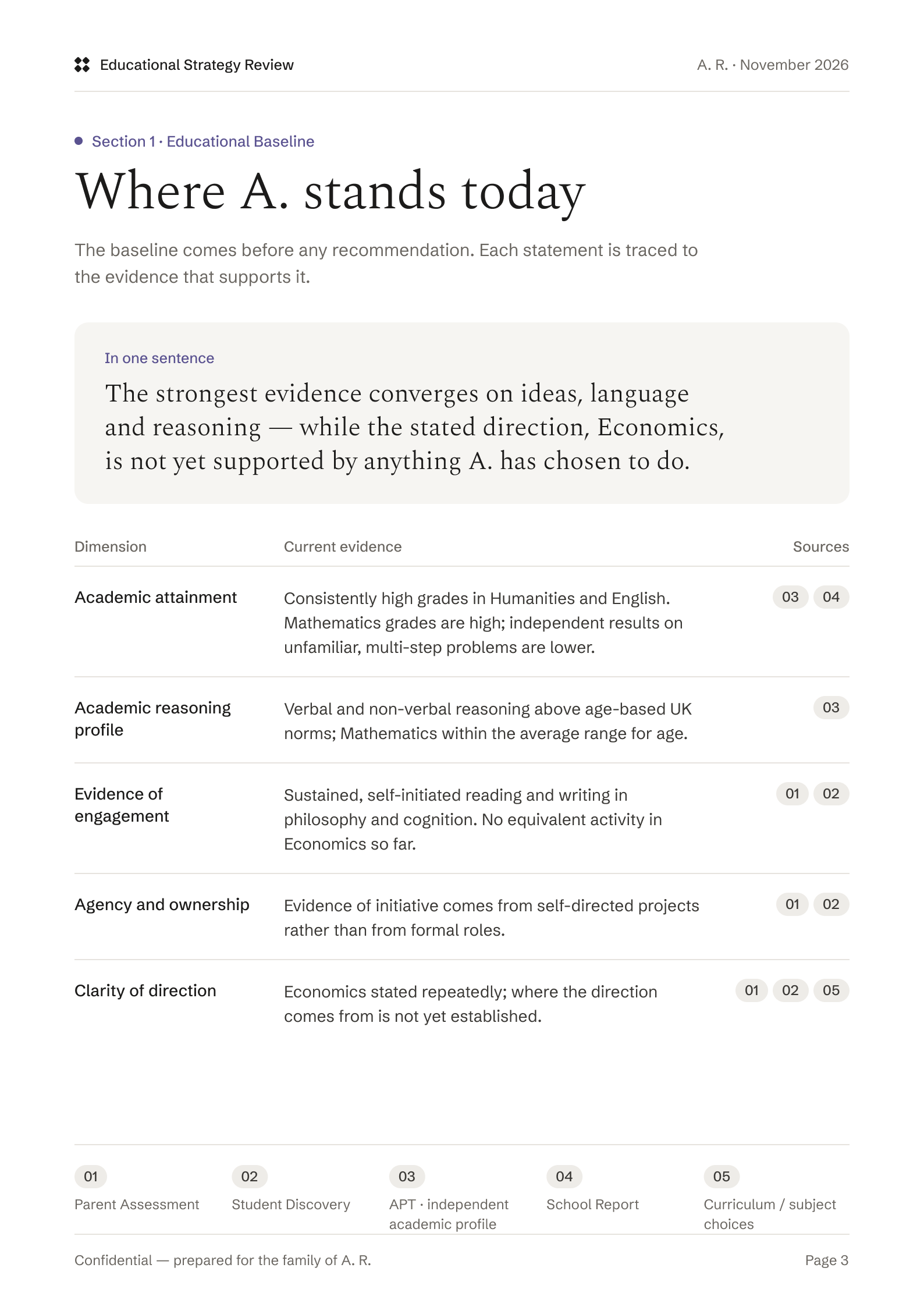
  1. 01Which of my child’s apparent strengths are actually supported by evidence?Educational Baseline · p. 3
  2. 02Which interests are genuine, emerging or still untested?Evidence Status · p. 5
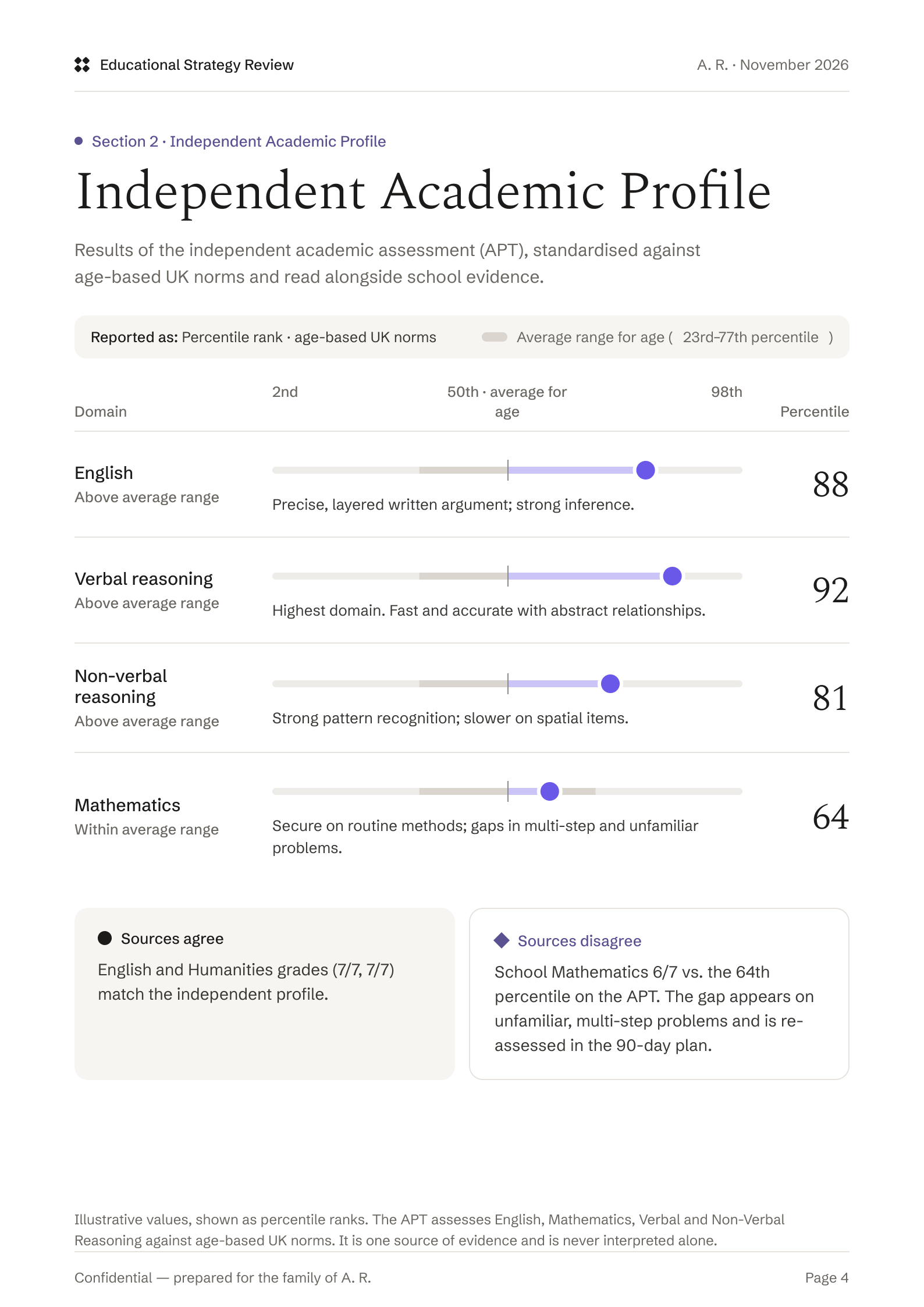
  3. 03Where is there a mismatch between ability, performance and engagement?Independent Academic Profile · p. 4
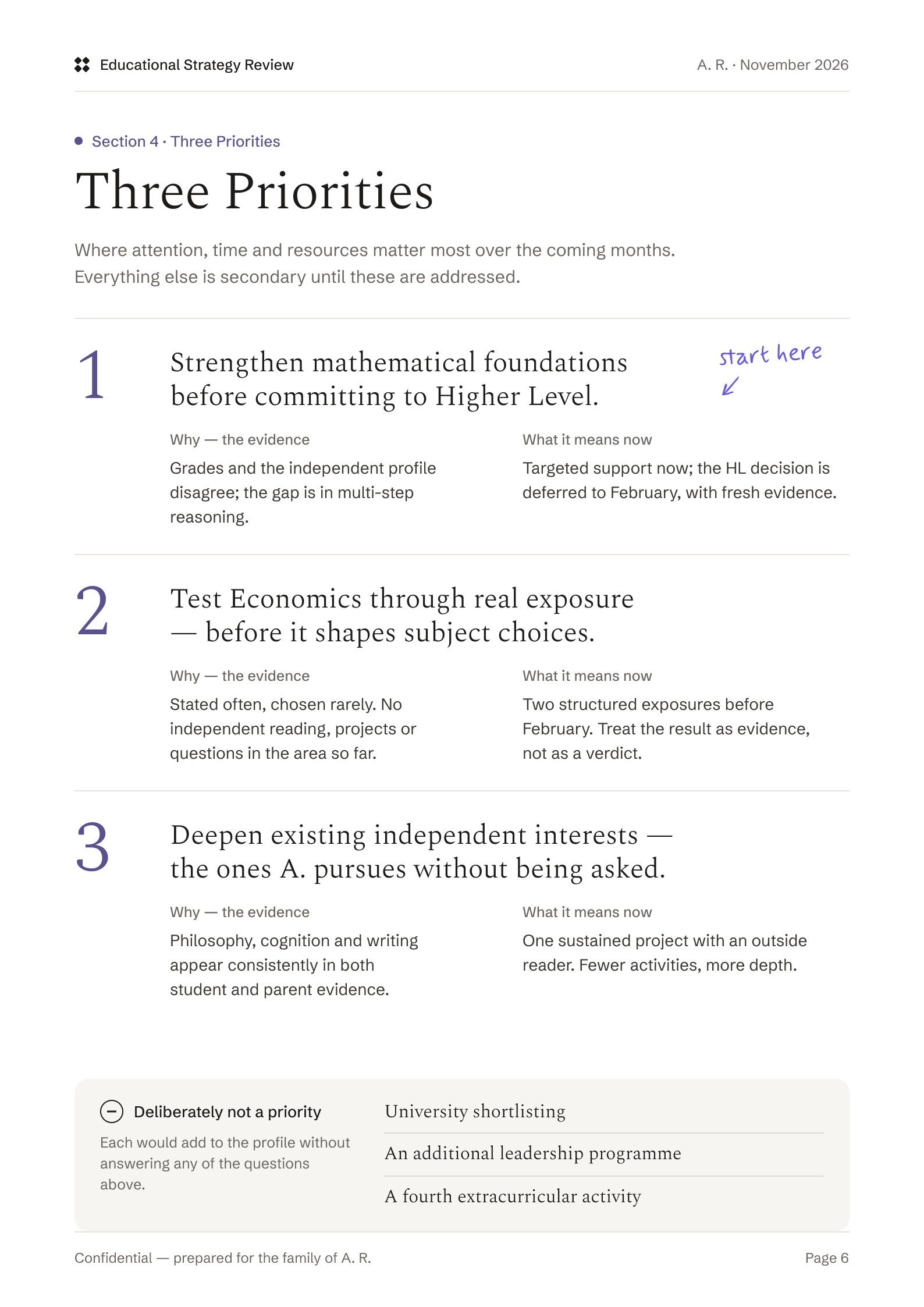
  4. 04Where should we invest time and money over the next 12 months?Three Priorities · p. 6
  5. 05Which decisions require action now?Decision Horizon · p. 7
  6. 06Which decisions are we unnecessarily rushing?Decision Summary · p. 2
  7. 07What should we deliberately not do yet?Three Priorities · p. 6
  8. See every answer in a full sample Review.
The Review

See the Review before you start yours.

A sample Educational Strategy Review for a 15-year-old approaching IB subject choices. Details are illustrative; every Review is built from the family’s own evidence.

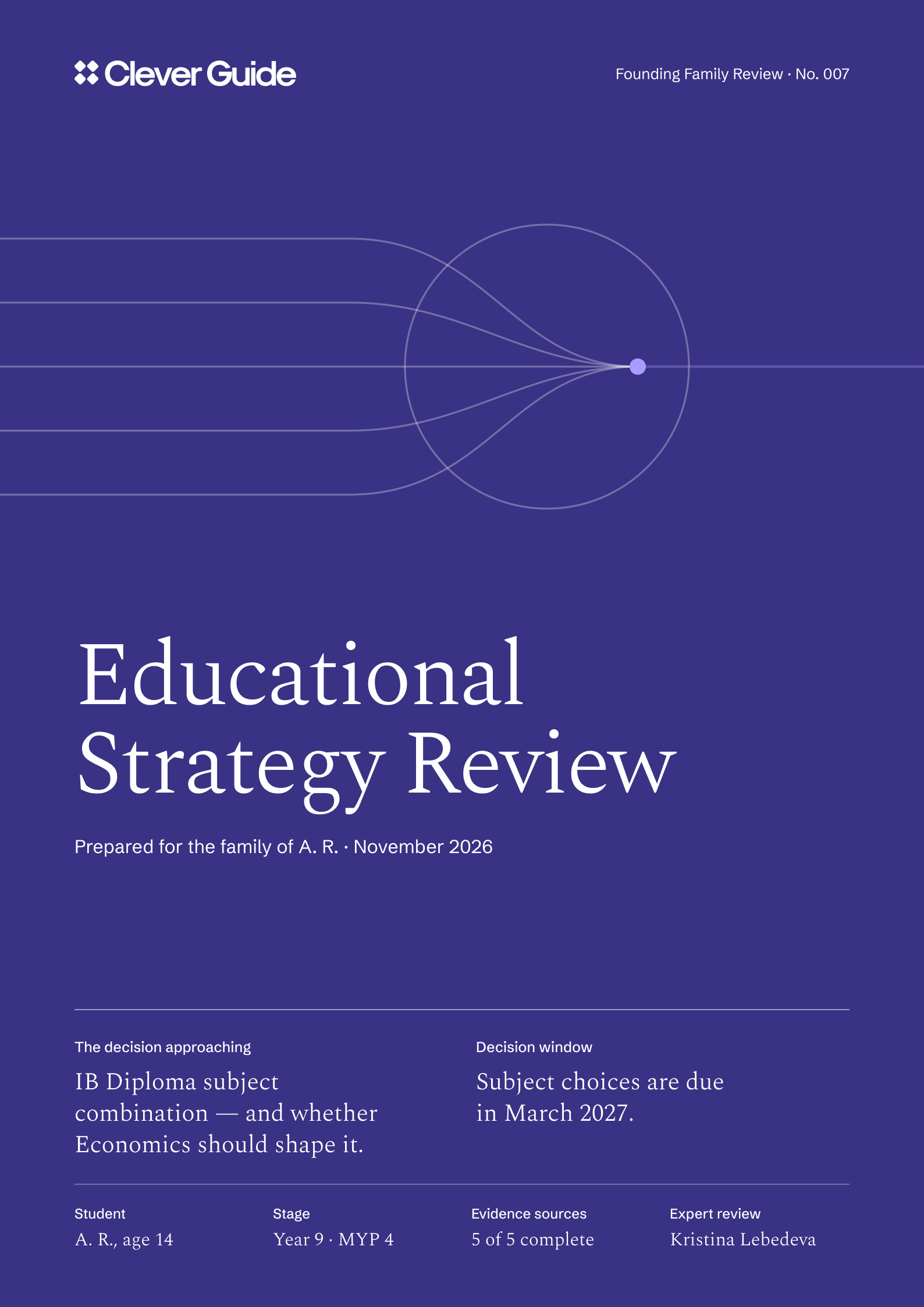
Sample Review, page 1: Cover
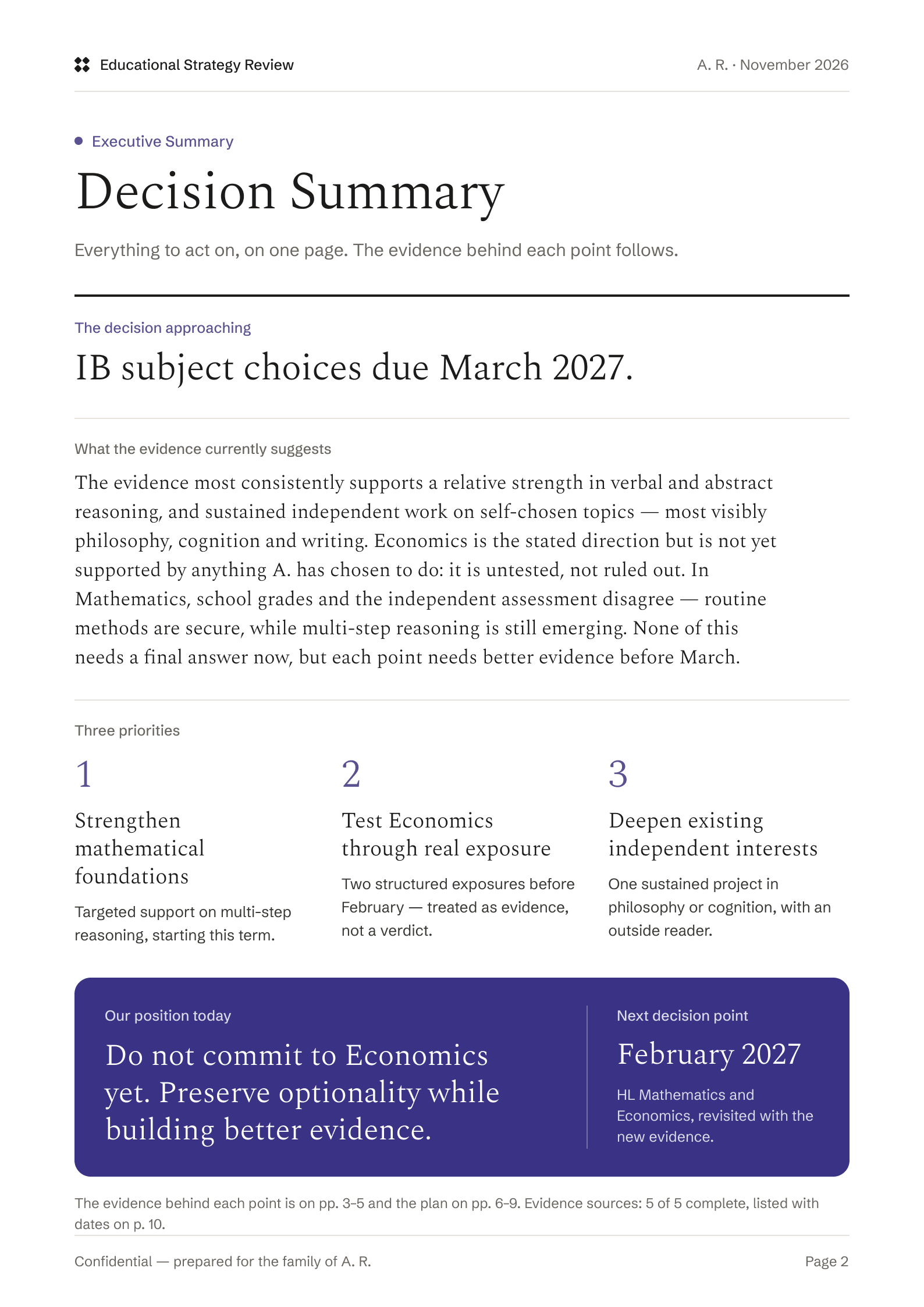
Sample Review, page 2: Decision Summary
Sample Review, page 3: Educational Baseline
Sample Review, page 4: Independent Academic Profile
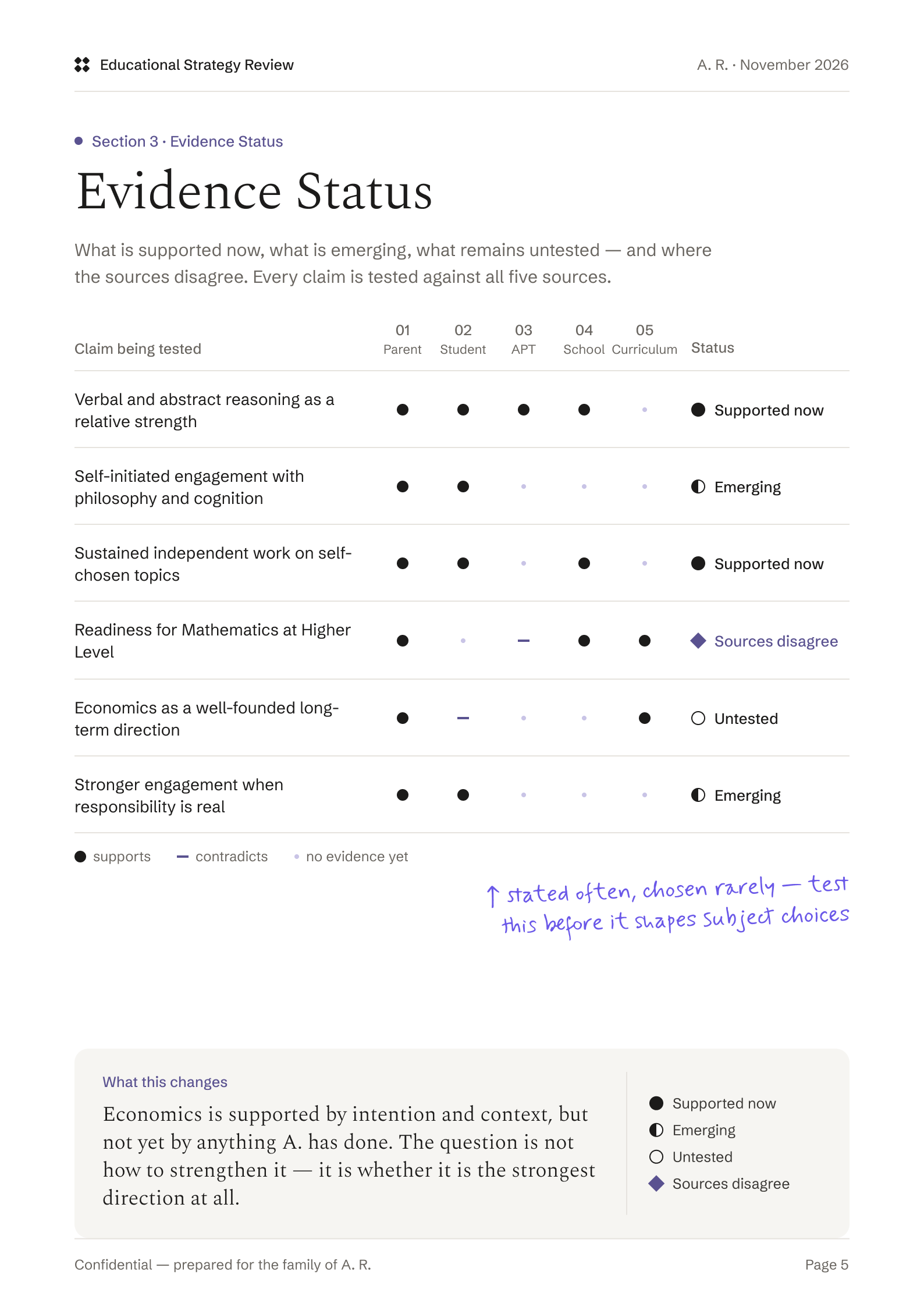
Sample Review, page 5: Evidence Status
Sample Review, page 6: Three Priorities
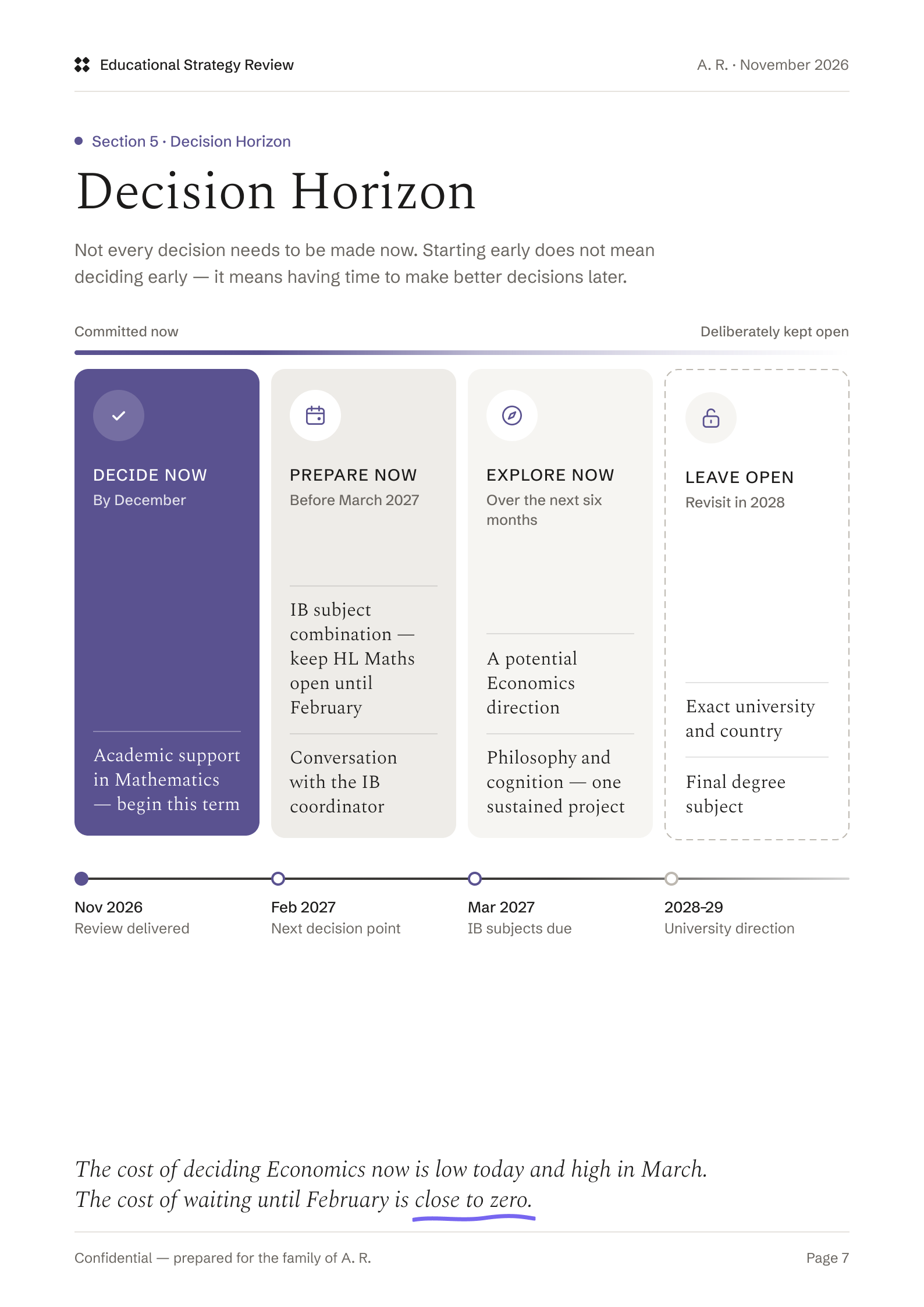
Sample Review, page 7: Decision Horizon
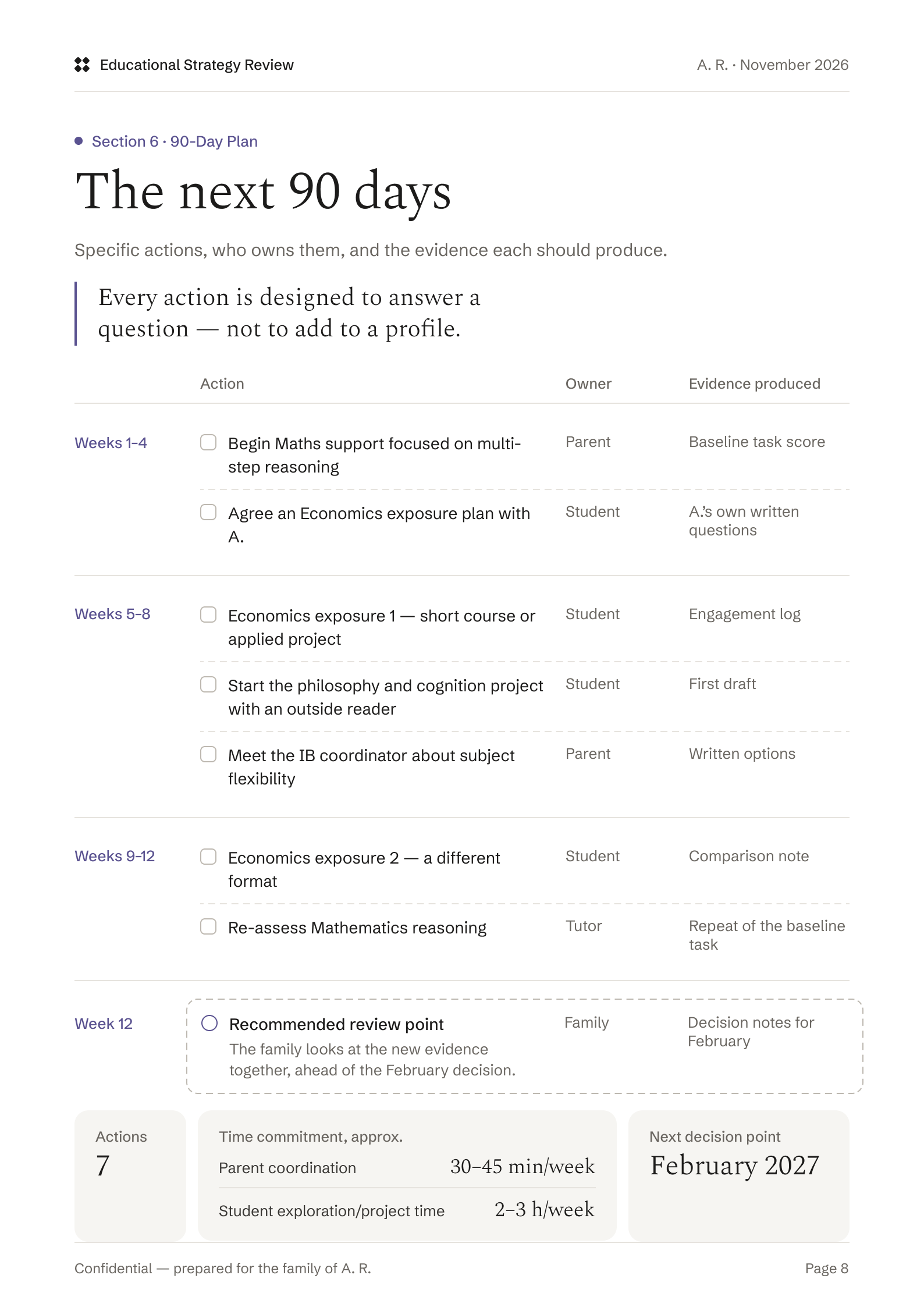
Sample Review, page 8: 90-Day Plan
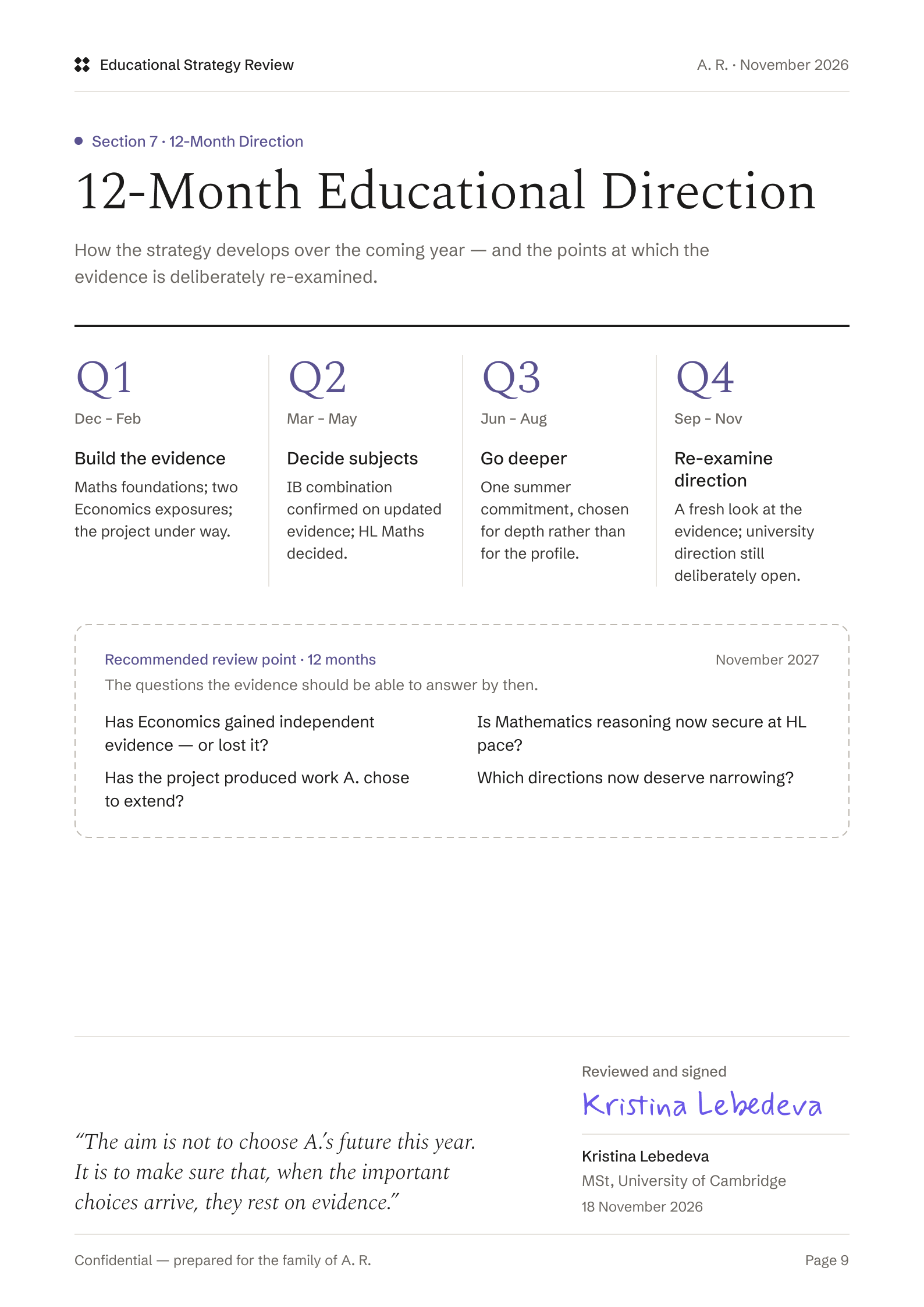
Sample Review, page 9: 12-Month Direction
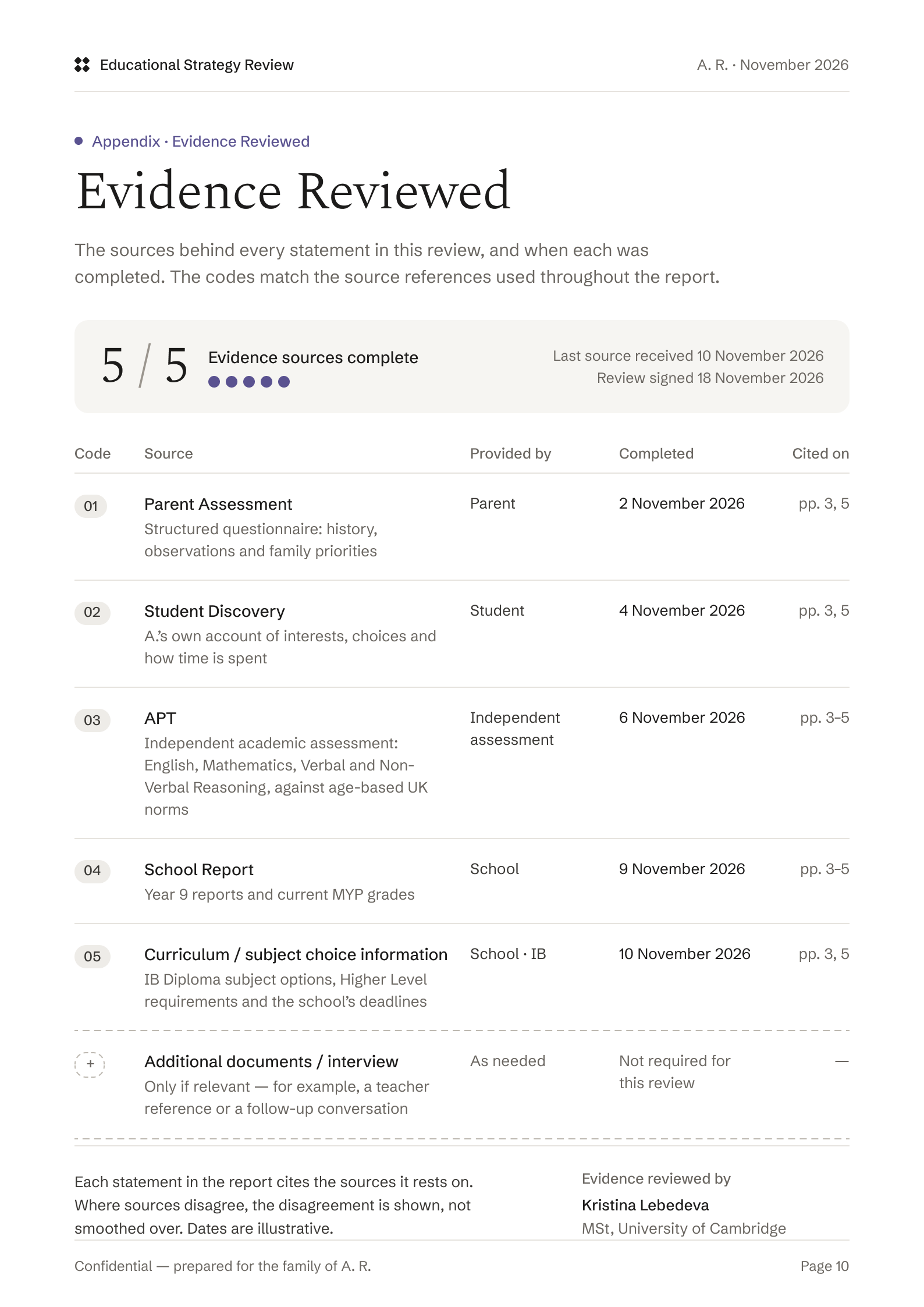
Sample Review, page 10: Evidence Reviewed
Page 2 of 10 · Decision Summary

What would this say about your child?

The product

Five sources of evidence.
One educational strategy.

  1. Independent Academic Profile01
  2. School Performance & Trajectory02
  3. Student Evidence03
  4. Parent Evidence04
  5. Educational Context05
Educational Strategy
IndependentAcademicProfile StudentEvidence EducationalContext SchoolPerformance& Trajectory ParentEvidence 0103050204
Educational Strategy

We compare different forms of evidence to identify reinforcement, gaps and contradictions — before turning them into priorities and decisions.

ReinforcementGapsContradictions
How Clever Guide thinks

Claims are not evidence.

A child saying “I want to study Economics” is information. But we then ask:

  1. 1What have they actually done independently in this area?
  2. 2What do they read, research or create without being asked?
  3. 3Which subjects do they genuinely enjoy?
  4. 4What evidence exists outside school?
  5. 5Is the direction coming from the child, the parent, prestige, security or genuine engagement?
  6. 6Would they still choose it if university prestige or salary disappeared from the equation?

The point is not to disprove aspirations. It is to understand how strongly they are actually supported.

Worked case

When the evidence changes the question.

The family behind the sample Review above. Open their Decision Summary

The family arrived asking

“How do we strengthen an Economics pathway?”

The evidence showed
  • Strong verbal and abstract reasoning.
  • Economics frequently stated as the intended direction.
  • Very little independent engagement with Economics.
  • Much more voluntary engagement with philosophy, cognition and writing.
The real question became

Is Economics genuinely the strongest direction — or simply the direction that has been assumed?

The strategic response
  1. 1Do not decide yet.
  2. 2Test Economics through meaningful exposure.
  3. 3Deepen the stronger existing intellectual interests.
  4. 4Preserve subject optionality.
  5. 5Review the direction again once there is better evidence.

Decision Horizon

Not every decision needs to be made now.

Academic support in mathematicsDecide now
IB subject combinationPrepare now
Potential Economics directionExplore now
Exact universityLeave open

Starting early does not mean deciding early. It means having enough time to make better decisions later.

How it works

How the journey works

Your family’s part takes about 2–3 hours in total, spread over several days. Most families have their Review within 1–2 weeks.

  1. 1UnderstandYour family · online
    • 01Parent Assessment15–20 min
    • 02Student Discovery20–25 min
  2. 2Establish the evidenceYour family · over several days
    • 03Independent Academic Assessment (APT)90 min–2 h, in modules
    • 04School evidence upload3–5 min
  3. 3InterpretClever Guide · 5–7 business days
    • 05Integrated Evidence Analysis
    • 06Expert Review
  4. 4ActTogether
    • 07Your Educational Strategy Review
    • 0830-Minute Review InterpretationBooked once your Review is ready
Methodology

Built from 15+ years of international education advisory experience.

Clever Guide is built from the methodology and experience developed through 15 years of advising international families on school, curriculum and university decisions.

Kristina Lebedeva
Kristina Lebedeva MSt in Coaching, University of Cambridge Founder, Lebedeva Education (Switzerland) Global Education Advisor, Henley & Partners President, Cambridge Coaching Society
The experience behind the Clever Guide methodology
15+
years of international education advisory experience
500+
families advised
Case studies

Selected cases from advisory practice

Case 01

When the stated ambition was not the strongest evidence

Stop treating the original ambition as a fixed destination.

The family came asking…

How to strengthen a highly academic student’s pathway toward Economics/PPE and competitive university applications.

The evidence revealed…

Economics and PPE were the stated ambitions, but the student’s voluntary intellectual behavior showed much deeper engagement with philosophy, cognition, literature and abstract questions than with Economics itself.

The strategy changed to…
  • Explore the subjects the student was already choosing independently
  • Preserve academic optionality
  • Build the application around the stronger evidence of genuine intellectual engagement
Case 02

When “leadership” was the wrong intervention

Do not prescribe an activity simply because it carries the word “leadership.”

The family came asking…

How to develop leadership in a thoughtful, reserved student — with the initial instinct being to add a leadership camp or another formal program.

The evidence revealed…

The student was not lacking capability. Their agency appeared in quieter but more meaningful ways: making considered choices, taking ownership of important decisions and functioning better in environments where responsibility felt authentic rather than performative.

The strategy changed to…

Create situations involving real responsibility, contribution, voice and ownership in a context that fits the student naturally.

Case 03

When achievement and activity volume disguised the real priority

Move away from accumulating more credentials.

The family came asking…

How to strengthen the profile of a highly achieving student with many activities, school responsibilities and visible leadership roles.

The evidence revealed…

There was considerable achievement, but some of the motivation was tied to titles, recognition, being “the best” and external validation. At the same time, there were signs of authentic creative interest that had not yet been developed with the same depth.

The strategy changed to…
  • Reduce breadth
  • Deepen genuine interests
  • Create opportunities for contribution rather than status
  • Strengthen humility, resilience and responsibility
Case 04

When relocation looked simple but the academic transition was not

Verify the academic transition before making the lifestyle decision.

The family came asking…

How to move a student between countries and schools while keeping the broader educational plan on track.

The evidence revealed…

The real risk was not the move itself but curriculum continuity: credits, graduation requirements, subject sequencing and whether the receiving school could actually preserve the student’s intended pathway.

The strategy changed to…

Establish exactly what transfers, what does not, and which choices could become difficult to reverse before committing to the move.

Case 05

When the visible deadline was not the real problem

Stop optimizing for the visible deadline.

The family came asking…

How to accelerate preparation for an upcoming mathematics requirement.

The evidence revealed…

The immediate deadline created urgency, but the real issue sat much earlier: important mathematical foundations from previous years had never become secure.

The strategy changed to…

Rebuild the prerequisites first, then accelerate only once the foundation is strong enough to support the next level.

Case 06

When real experience changed the meaning of a career ambition

Keep Medicine open.

The family came asking…

How to position a student who was already strongly considering Medicine.

The evidence revealed…

The ambition itself was genuine, but practical exposure showed that the student was particularly drawn to patient-facing, clinical work rather than research-heavy or laboratory-based environments.

The strategy changed to…

Use the new evidence to refine what kind of medical education and future working environment might actually fit the student.

Case 1 of 6
Why now

The best time to examine a decision is before it becomes difficult to reverse.

Subject choices, school moves, curriculum changes and educational investments often shape what becomes easier or harder later. Clever Guide helps families understand what deserves attention now — without forcing decisions that do not yet need to be made.

Founding Family Program

Educational Strategy Review

For families with children approximately 12–15, approaching an educational decision.

Founding Family fee
$1,490
One-off paymentNo subscription
  • Full Review delivered approximately 5–7 business days after all evidence is received.
  • The full journey typically takes 1–2 weeks.
  • Every Review is expert-reviewed, with a 30-Minute Review Interpretation included.
  • First cohort limited to 10 families.
Start Your Review — $1,490

Secure payment through Stripe. You begin the Review straight after.

What happens after you start
  1. Pay securelyOne payment through Stripe Checkout.
  2. Begin the Parent AssessmentStraight from your welcome page — about 15–20 minutes.
  3. Receive your next linksStudent Discovery for your child, APT instructions and a secure document upload.
  4. Receive your ReviewAbout 5–7 business days after all evidence is in, then your 30-Minute Review Interpretation.
Everything included
  • Parent Assessment
  • Student Discovery
  • Independent Academic Assessment (APT)
  • School evidence review
  • Integrated Evidence Analysis
  • Expert Review
  • Decision Summary
  • Educational Baseline
  • Evidence Status
  • Three Priorities
  • Decision Horizon
  • 90-Day Plan
  • 12-Month Educational Direction
  • 30-Minute Review Interpretation
Not sure whether the Review is right for your family?A complimentary 15-minute call to check fit — not an advice session. Book a 15-minute Fit Call

FAQ

Is this a career assessment?

No. It is not a career test, an aptitude test or a university-matching tool. It looks at the educational decisions ahead — subjects, curriculum, school, where to invest — and at what the evidence actually supports.

What age is it designed for?

Approximately 12–15.

How does the process work?

You complete the Parent Assessment. Your child completes Student Discovery and the Independent Academic Assessment (APT), and you upload recent school documents. Clever Guide then brings the evidence together, the Review is expert-reviewed, and you receive it with a 30-Minute Review Interpretation.

How long does it take?

The Review is designed to be completed around family schedules and does not need to be done in one sitting.

Parent Assessment: approximately 15–20 minutesThe parent completes a structured assessment covering the child’s strengths, current priorities, educational investments, upcoming decisions, aspirations and areas of uncertainty.

Document upload: approximately 3–5 minutesParents upload recent school reports, grades and any other relevant academic information.

Student Discovery: approximately 20–25 minutesThe student completes a separate assessment exploring interests, independent behavior, motivation, curiosity, agency and the evidence behind stated ambitions.

Independent Academic Assessment (APT): approximately 90 minutes for ages 12–13 and up to 2 hours for ages 14–15APT is completed separately and can be broken into modules with breaks. It assesses English, Mathematics, Verbal Reasoning and Non-Verbal Reasoning.

Report turnaround: approximately 5–7 business daysAfter all required information has been received, for analysis, expert review and preparation of the final Review.

Most families should expect the full journey — from completing the assessments to receiving and discussing their Review — to take approximately 1–2 weeks.

How does payment work?

One payment of $1,490 through Stripe Checkout. It is a one-off Founding Family fee — no subscription and no further charges. The 30-Minute Review Interpretation is included.

What happens after I pay?

Stripe takes you straight to your welcome page, where you can begin the Parent Assessment (15–20 minutes). Once it is complete, you receive the Student Discovery link for your child, instructions for the APT and a secure link to upload school documents.

When all the evidence is in, your Review is delivered in about 5–7 business days, with a private link to book your 30-Minute Review Interpretation.

Is AI making the recommendations?

No. Technology helps gather and structure evidence. The methodology determines what is examined, and every Founding Family Review is expert-reviewed.

Can I speak with someone before purchasing?

Yes. If you are unsure whether the Review is appropriate for your family, you can book a complimentary 15-minute Fit Call. This is designed to establish fit rather than provide educational advice.

Book a 15-minute Fit Call
Does my child need to know what they want to do?

No. Uncertainty at this stage is often entirely appropriate.

What if my child already has a clear ambition?

We test the evidence supporting it rather than automatically accepting or rejecting it.

Why are you starting with only 10 families?

Because this is the first live cohort of the new Educational Strategy Review. We want to validate the methodology carefully before adapting the full Clever Guide platform.